Written by Amy Tuscher

The Sydney Sweeney advert has sparked a backlash — but the bigger conversation is about what it tells women and girls about their place in sport
Women’s sport has spent decades fighting to be seen for what it is: elite competition and worthy of adequate and equal opportunities.
Yet a new advertising campaign featuring Hollywood actress Sydney Sweeney has sparked an uncomfortable question: when women’s sport is enjoying unprecedented momentum, why are we still falling back on sexualisation to sell it?
Sweeney stars in a campaign for sports prediction platform Novig, built around the phrase “Just Sports.” The actress appears in provocative scenes involving sporting equipment, with the campaign deliberately playing on nudity and sexual imagery.
Sweeney has described the campaign as a playful way of cutting through the noise and putting the focus on sport. Importantly, she isn't simply a celebrity hired to front the advert: she has also joined Novig as a strategic partner and equity holder.
But for many female athletes, the campaign achieves almost exactly the opposite. Instead of putting the focus on sport, they believe it once again puts the focus on a woman’s body, and that distinction matters.
“This is what a woman in sport looks like”
The backlash has not simply come from social media commentators looking for the latest controversy, rightly so, some of the strongest responses have come from women who dedicate their lives to elite sport.
Team GB sprinter Amy Hunt has been among those to voice her concerns on the advert. Following her performance at the Diamond League final in Brussels, Hunt used her post-race interview to respond to the controversy, declaring:
“Sydney, this is what real women in sports look like.”
Her response echoed a wider movement among female athletes who have countered the campaign with images and footage of themselves training and competing.
Four-time Olympic swimming champion Ariarne Titmus has also been among the outspoken international critics, describing the campaign as infuriating and questioning why the sexualisation of women around sport continues to be used commercially.
Their responses get to the heart of the controversy. This isn't really about whether Sydney Sweeney should be allowed to pose provocatively. Of course she should and of course she can. A woman choosing to embrace her sexuality does not make her responsible for the challenges women face in sport still to this day.
The bigger question is why, in 2026, a sports company or betting company still believes sexualising the female body is an effective way to attract attention to its product.
Women’s sport has fought too hard to go backwards
Female athletes have spent generations fighting against the idea that their value is determined by their appearance.
Footballers want to be discussed for what they do with a football. Boxers for their performances in the ring, their records and world titles. Rugby players for their tackles and tries. Cricketers for what they achieve with bat and ball.
Historically, however, women in sport have often faced another conversation — one centred on their bodies, clothing, attractiveness and sexuality, that is why context matters.
If this were simply a provocative celebrity campaign unrelated to sport, the discussion would be different. But when sporting imagery is being used to sell a sporting product or a sports betting product, it enters an industry where women have fought hard to ensure their athletic ability comes before their appearance.
When the central creative idea appears to be woman + nudity + sporting equipment, it risks reinforcing precisely the stereotype female athletes have spent years trying to escape.
Think about the young girl watching
Perhaps the most important part of this conversation isn't about today's professional athletes at all, it's about tomorrow's.
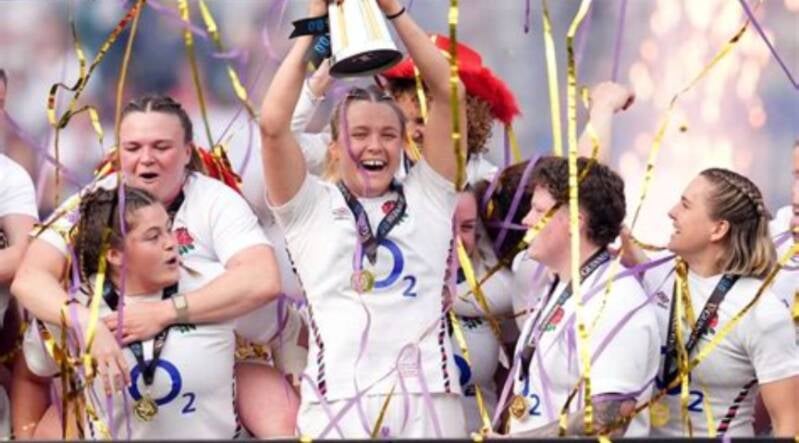
Imagine a young girl discovering sport, she watches the Lionesses walk out in front of packed stadiums and sees female footballers becoming household names. She watches the Red Roses and sees strength, physicality and toughness celebrated at the highest level.
She discovers boxing and sees British women winning world titles, she watches athletics and sees women sprinting, jumping and throwing on the biggest stages in world sport. She watches cricket and sees England's women representing their country in front of growing crowds.
Together, those images deliver a simple message:
You can belong here.
That matters because the growth of women's sport isn't simply about audiences, sponsorship deals or ticket sales. It is also about whether the next generation believes sport is a place for them.
And the evidence suggests there is still considerable work to do.
More than one million girls disengaging from sport
Research by UK charity Women in Sport, funded by Sport England, found that 43% of teenage girls who once considered themselves “sporty” disengage from sport following primary school.
That represents more than one million teenage girls.
For boys, the equivalent figure was 24%.
These aren't necessarily girls who never enjoyed sport, they are girls who did. The reasons behind that disengagement are particularly important.
Women in Sport found that 68% cited fear of feeling judged by others as a barrier to participating, while 61% cited a lack of confidence. Body image and puberty were also identified as significant factors.
Perhaps most strikingly, 73% said they don't like other people watching them take part in physical activity. Those figures should concern everyone involved in sport. During puberty, girls can become increasingly conscious of their changing bodies and how other people perceive them.
Sports kit can become uncomfortable, especially for young girls and women having to wear white shorts during their periods. Exercising in front of classmates can become intimidating. Fear of being watched or judged can replace the enjoyment that once came with simply playing. And these concerns don't necessarily disappear in adulthood.
Research highlighted by Sport England's This Girl Can campaign found that women identified worries about not being fit enough (41%), what other people think of them (32%), showing their body (31%) and wearing tight clothing (20%) among barriers surrounding exercise.
More than a third — 38% — said they had felt judged when exercising.
For too many girls and women, the question can shift from:
“Am I good enough?” to: “Do I look good enough?”
Sport should challenge that, it should teach girls to appreciate what their bodies can do, rather than obsess over how they look.
How fast can I run? How strong can I become? How well can I play?
Those are the questions sport should encourage.
Not: Do I have the right body to belong here?

Why advertising matters
One advertisement is not responsible for more than one million teenage girls disengaging from sport, of course it isn't. But advertising does not exist in isolation.
Girls grow up surrounded by carefully curated images across social media, advertising and popular culture, often during the same period when they are becoming most self-conscious about their bodies.
So when a sports betting company places an idealised, sexualised female body at the centre of a campaign, it is reasonable to ask:
Does this challenge the idea that a woman's appearance determines her value — or does it reinforce it?
That question becomes more important when research tells us that fear of judgement, confidence and body image already affect participation.
Representation isn't simply about putting women on screen. It is about how we show them and what we tell girls their value is. If sport want girls to believe they belong, its imagery should support that message rather than complicate it.
There isn't one body type for sport.
Elite women's sport demonstrates something advertising often fails to show: there is no single athletic female body. A rugby prop doesn't have the same physique as a 100-metre sprinter, a heavyweight boxer doesn't look like a gymnast, a goalkeeper doesn't necessarily look like a winger, a cricketer doesn't have to look like an athlete from the track. Different sports demand different strengths, that should be celebrated.
British sport already has extraordinary examples. Young girls can watch the Lionesses and see women celebrated for what they achieve with a football. They can watch the Red Roses and see physical strength celebrated rather than apologised for. They can see Keely Hodgkinson and Dina Asher-Smith competing on the track, Lauren Price succeeding in the boxing ring, Ellie Kildunne starring on the rugby pitch and Amy Hunt sprinting on the world stage.
Different sports, different physiques, different strengths. They are all athletes and they are all successful. All demonstrating what women's bodies are capable of achieving. There is room for everybody — and every body.
Women’s sport doesn't need this anymore
Perhaps what makes this controversy particularly frustrating is that women's sport has already demonstrated its commercial power.
Women's boxing can headline major arenas and stadiums, look at Katie Taylor - headling at Croke Park in front of over 83,000 fans.
Women's football has created household names and huge crowds, consistently selling out huge crowds, even Wembley - a feat some times not even the men's team can achieve
Women's rugby has attracted enormous audiences, grown the game and sold out the Alliance Stadium. Women's cricket continues to grow its profile. British female athletes regularly compete for Olympic, Paralympic, world and European honours.
For years, sceptics asked: “Who is going to watch women's sport?”
The answer has become increasingly clear, millions will and do!
The personalities are there, the rivalries are there, the drama is there.
Most importantly, the sporting ability and excellence is there.
So why return to an advertising formula that suggests female sexuality is needed to make sport interesting?
Sexuality isn't the enemy
There is an important distinction though. A woman can be an elite athlete and embrace her sexuality and beauty. A sportswoman choosing to appear in a glamorous photoshoot does not diminish her achievements.
Women should not be told how they are permitted to present themselves in the name of protecting women's sport. The issue is the context and what is being sold.
There is a difference between a woman choosing how she presents herself and a sports company using sexualisation as the central device for attracting attention to its product.
Criticism should also extend beyond Sweeney herself.
This campaign involved a company, marketers, creatives and executives. Sweeney is its most visible participant — and has a commercial stake in Novig — but turning the entire debate into an attack on one woman would miss the broader point.
The conversation should be about the choices the sports and advertising industries make. Perhaps the backlash was the point
There is also another possibility.
Maybe the controversy means the campaign has worked. An advert people dislike can travel much further than one they simply ignore.
The arguments generate comments, comments generate engagement and engagement generates reach. Reach generates brand recognition.
Sweeney's previous American Eagle campaign became a huge online talking point in 2025 after its “great jeans/genes” wordplay sparked debate over beauty standards, race and representation.
Novig has now created another campaign capable of dominating conversation. If its intention was to cut through the noise, it certainly succeeded. But attention and success aren't necessarily the same thing. There is a difference between people remembering your advertisement and people respecting what your brand represents.
Women deserve to be part of sport — not decoration around it
Perhaps the most powerful response to this controversy has come from the athletes themselves. Women sprinting, women swimming, women boxing, women playing football, women making tackles, women hitting sixes, women competing.
Women winning.
That is what women in sport look like.
There is nothing wrong with Sydney Sweeney being sexy, and female empowerment cannot mean telling another woman what she is permitted to do with her body.
But the sporting industry is entitled to question why sexualisation remains such an attractive advertising shortcut. Especially when Women in Sport's research found that 43% — more than one million — of teenage girls who once considered themselves sporty disengage from sport following primary school, while fear of judgement, lack of confidence and body image remain barriers.
If we want more girls to remain in football, rugby, cricket, boxing, athletics and sport generally, we need to build an environment in which they feel represented and wanted. We should be breaking down the idea that you have to look a certain way to belong in sport — not inadvertently feeding it.
We don't need to remove women's sexuality from sport, we need to reach the point where it is no longer required to sell it. Young girls should look at the Lionesses and the Red Roses and think:
I could do that.
They should watch Meg Jones, Amy Hunt, Keely Hodgkinson, Dina Asher-Smith, Lauren Price, Ellie Kildunne and Britain's other female sporting stars and think:
"There is a place here for me"
Because after everything women's sport has achieved, female athletes shouldn't still have to remind advertisers of something that should have been understood a long time ago:
Women in sport deserve to be valued for what they can do — not simply for how they look. And every young girl watching deserves to know that, whatever her shape or size, she belongs in sport too.
Sources
The participation statistics referenced in this feature come from Women in Sport's “Reframing Sport for Teenage Girls” research, involving 4,000 teenage girls and boys and funded by Sport England.
Women in Sport — “More than 1 million teenage girls fall ‘out of love’ with sport”
Sport England — Gender and physical activity research
Sport England — This Girl Can research into the barriers preventing women from being activ
Add comment
Comments